

Male infertility can affect a couple’s ability to conceive naturally, and in many cases, sperm retrieval techniques play an important role in assisted reproductive treatment. Two commonly used procedures are TESA and PESA, both designed to retrieve sperm directly when ejaculation does not provide usable sperm for fertilisation.
Understanding the difference between TESA and PESA can help couples make informed decisions during fertility treatment. Although both procedures aim to retrieve sperm for IVF or ICSI, they differ in technique, purpose, and suitability depending on the underlying condition.
Understanding Male Infertility and Sperm Retrieval
Male infertility may occur due to:
- Low sperm count
- Absence of sperm in semen (azoospermia)
- Blockages in the reproductive tract
- Testicular dysfunction
In such situations, sperm retrieval procedures may help obtain viable sperm directly from the reproductive system.
TESA and PESA are minimally invasive methods commonly used along with IVF and ICSI treatment.
What Is PESA
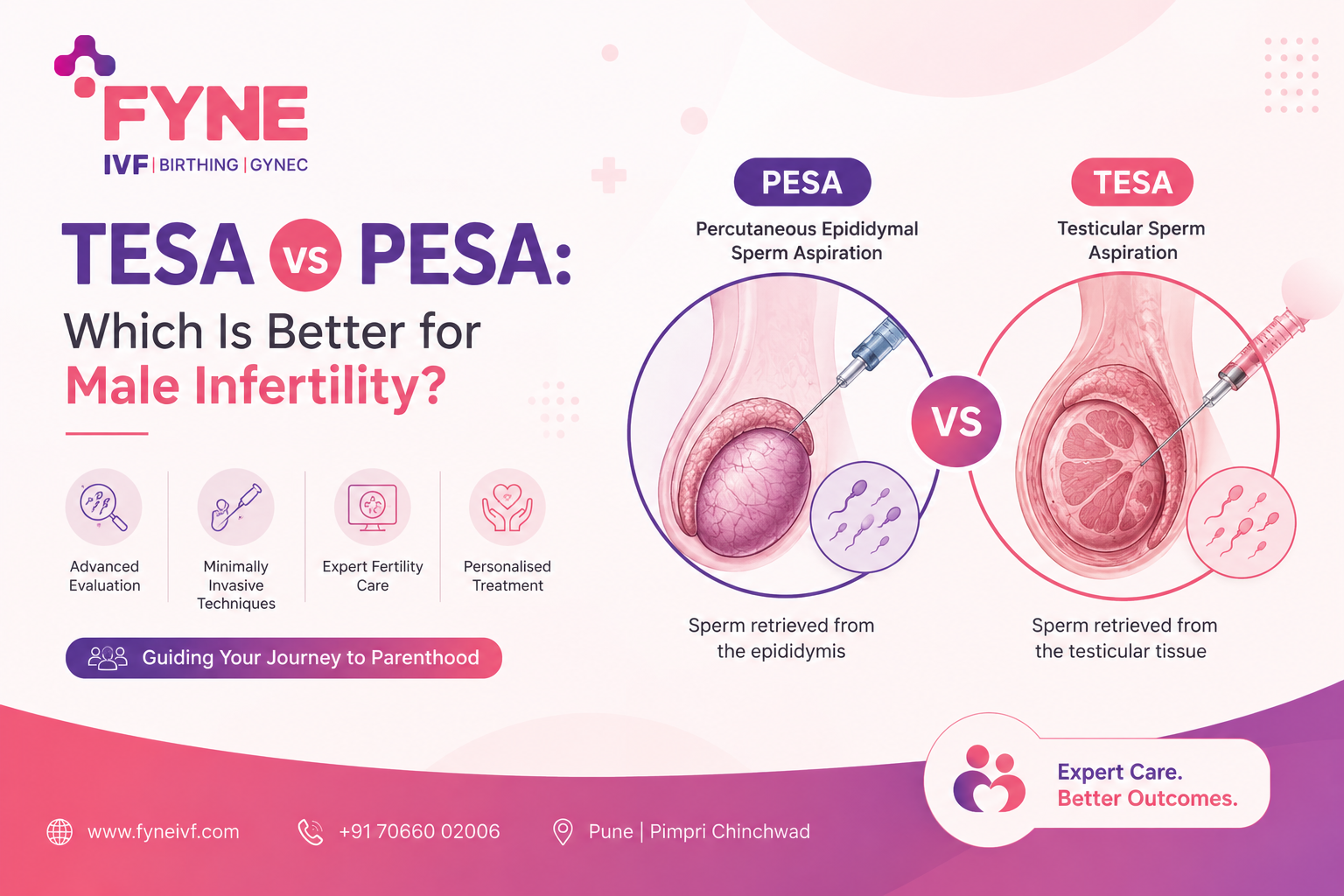
PESA stands for Percutaneous Epididymal Sperm Aspiration.
In this procedure:
- A fine needle is inserted into the epididymis
- Sperm is aspirated directly from the fluid filled tubes behind the testicles
PESA is generally recommended for men with obstructive azoospermia, where sperm production is normal but a blockage prevents sperm release.
What Is TESA
TESA stands for Testicular Sperm Aspiration.
In this technique:
- A needle is inserted directly into the testicular tissue
- Sperm is retrieved from the testes themselves
TESA may be recommended when sperm cannot be obtained through PESA or when sperm production is reduced.
Difference Between TESA and PESA
| Factor | PESA (Percutaneous Epididymal Sperm Aspiration) | TESA (Testicular Sperm Aspiration) |
| Site of Sperm Retrieval | Sperm is retrieved from the epididymis, the coiled tube located behind the testicle where sperm matures and is stored. | Sperm is retrieved directly from the testicular tissue using a fine needle aspiration technique. |
| Best Suited For | Commonly recommended for men with obstructive azoospermia, where sperm production is normal but blocked from reaching the semen. | Usually recommended for men with non obstructive azoospermia or significantly reduced sperm production. |
| Procedure Complexity | Considered a simpler and less invasive procedure with relatively quick sperm retrieval. | Slightly more invasive as it involves aspiration from the testicular tissue itself. |
| Type of Sperm Retrieved | Often retrieves mature sperm that has already passed through the natural maturation process. | May retrieve immature or fewer sperm cells depending on testicular sperm production. |
| Use in Fertility Treatment | Frequently used in IVF with ICSI when sperm blockage is the primary issue. | Often used when sperm cannot be obtained through ejaculation or epididymal aspiration. |
| Recovery Time | Recovery is usually quick with mild discomfort or swelling for a short duration. | Recovery may take slightly longer due to deeper tissue aspiration, though discomfort is generally manageable. |
| Success Depends On | Success largely depends on the presence and location of the blockage. | Success depends on the level of sperm production within the testes. |
Which Procedure Is Better
There is no single procedure that is universally better. The choice depends on:
- Cause of male infertility
- Sperm production levels
- Presence of reproductive tract blockage
- Previous fertility treatment history
Are TESA and PESA Painful
Both procedures are minimally invasive and usually performed under local anaesthesia or mild sedation.
Most patients experience:
- Mild discomfort
- Temporary swelling
- Minor soreness for a short duration
Recovery is generally quick.
Success Rates of TESA and PESA
Success depends on:
- Underlying fertility condition
- Sperm quality
- Female partner’s reproductive health
- IVF or ICSI outcomes
In many cases, retrieved sperm can be successfully used for fertilisation through ICSI.
Recovery After TESA or PESA
Most individuals recover within a few days.
Doctors may recommend:
- Avoiding strenuous activity temporarily
- Wearing supportive undergarments
- Taking prescribed medications if needed
Any severe pain or swelling should be reported immediately.
When Are TESA or PESA Recommended
Your fertility specialist may suggest these procedures if:
- No sperm is present in semen analysis
- Previous vasectomy blocks sperm release
- Ejaculation difficulties prevent sperm collection
- IVF with ICSI is planned
Understanding Male Fertility Treatment with Confidence
Understanding the difference between TESA and PESA can help couples feel more informed and prepared during fertility treatment. Both procedures offer effective sperm retrieval options and have helped many couples move forward successfully with assisted reproduction.
At Fyne IVF, our fertility specialists provide advanced evaluation and personalised treatment plans for male infertility conditions. From diagnosis to sperm retrieval and IVF support, every step is carefully planned to improve treatment outcomes and support your parenthood journey.
Book your consultation today and take the next step towards informed and personalised fertility care.
FAQs
1. What is the main difference between TESA and PESA?
PESA retrieves sperm from the epididymis, while TESA retrieves sperm directly from the testicular tissue.
2. Which is less invasive, TESA or PESA?
PESA is generally considered less invasive compared to TESA.
3. Are TESA and PESA used with IVF?
Yes, both procedures are commonly used along with IVF and ICSI treatment.
4. How long is recovery after TESA or PESA?
Most patients recover within a few days with minimal discomfort.
5. Can sperm retrieved through TESA or PESA lead to pregnancy?
Yes, retrieved sperm can be successfully used in fertility treatments such as ICSI to achieve pregnancy.